Rebecca Papillon
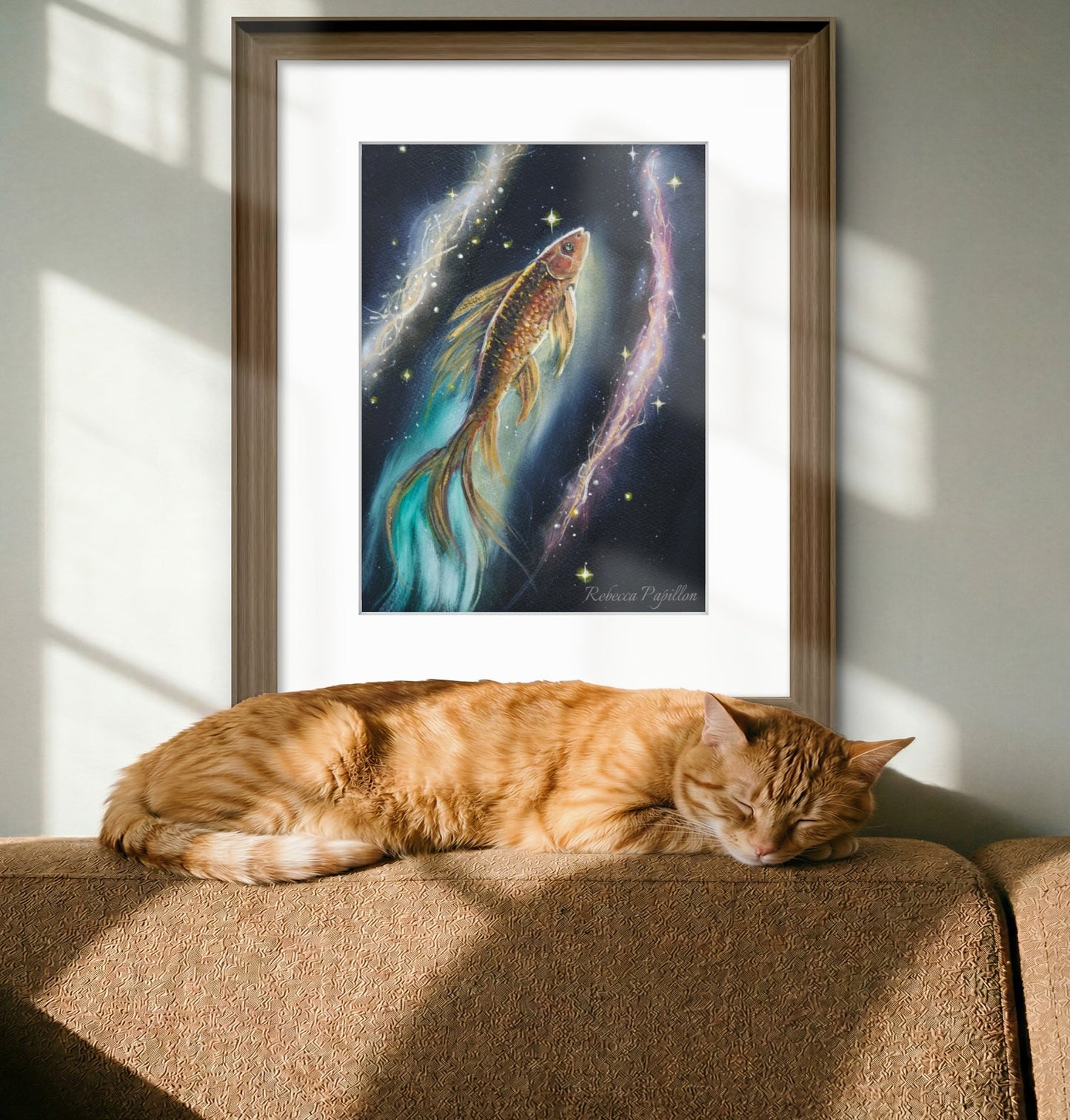
Animarii No.6: Koi — The One Who Becomes the Dragon · Fine Art Print
Animarii No.6: Koi — The One Who Becomes the Dragon · Fine Art Print
Couldn't load pickup availability
Fine art print produced in-studio on 300gsm heavyweight fine art paper using Epson’s premium ink system. Each print is made one sheet at a time and inspected before it leaves. Pieces small enough to be mailed flat are shipped in a rigid protective mailer; larger sizes travel in a protective tube.
Called Nishikigoi — brocaded carp — the koi has been a living symbol of perseverance, transformation, and spiritual purpose for thousands of years across Chinese and Japanese tradition. At the heart of her mythology: a koi that swims the full length of the Yellow River against the current and leaps the waterfall at Dragon Gate is transformed by the gods into a dragon. She does not become the dragon by being exceptional. She becomes it by not stopping.
Note: the original carries hand-applied foil in the eye and within the body — a shimmer beneath the surface that reveals itself as you move, unique to the original work.
This print is part of Animarii, a 12-piece series of original oil paintings on professional watercolor sheet by British-Californian artist Rebecca Papillon.
The printed image measures 9x12 inches, presented on an 11x14 inch sheet of 300gsm heavyweight fine art paper with gallery-standard weighted white borders: 1 inch on each side, 0.7 inches at the top, and 1.3 inches at the bottom.
The open edition carries a digital signature embedded within the image in the lower right corner. The limited edition is hand signed by the artist in pencil below the image in the white border, and individually numbered from the edition of 50.
Variants
— Open edition · Digital signature
— Limited edition · Hand signed and numbered in pencil on the border · Edition of 50
Sold unframed. The framed mock-up shown is for scale and framing inspiration only.
Framing guidance
This print frames beautifully in any standard frame with a 9x12 inch mat aperture. We recommend a 16x20 inch frame as the primary option — this gives a generous, gallery-standard mat with weighted spacing (slightly more border at the bottom than the top and sides, which is correct fine art framing convention). A 14x18 inch frame with the same 9x12 inch aperture works well for a closer, more intimate presentation. Both options are widely available. The 11x14 inch sheet fits comfortably within either frame with room for mounting. We recommend UV-filtering conservation glass or acrylic to protect the print over time — ask your framer for conservation glass or Museum Glass. Do not hang in direct sunlight — avoid placement opposite south- or west-facing windows and skylights.
Share